Workplace Wellbeing Workshops
The next generation of workplace wellbeing
Real conversations and real change for the workplace your people are actually living in every day.
Why These Workshops Are Different
This is the next generation of workplace wellbeing. The first generation was Employee Assistance Programme referrals and mindfulness apps that left the work entirely to the individual. The second generation was Mental Health First Aid awareness, which gave the workplace a vocabulary but stopped short of giving managers and leaders something they could actually do in the next one to one.
This generation sits at the nervous system level where capacity, regulation and sustainable performance actually live.
Book A Call To Discuss How We Can Transform Your Organisation →

What Workplaces See When This Work Lands
Published research from Gallup’s meta-analysis of 1.8 million employees across 230 organisations has consistently demonstrated the business impact of high employee wellbeing and engagement, with comparison between top and bottom quartile business units producing the following measurable shifts.
- 23% higher profitability in highly engaged business units
- 18% greater productivity in teams reporting strong wellbeing
- 81% lower absenteeism in highly engaged workforces
- 43% lower staff turnover in low-turnover organisations
- 64% fewer safety incidents across operational teams
- 10% higher customer ratings in customer facing roles
The Workplace Wellbeing Workshop Library
The Mental Wellbeing Company delivers trauma informed, physiology-first education designed to help organisations and professionals better understand domestic abuse and coercive control. The full suite covers seven trauma informed workshop packages that are already present in every workplace whether the organisation has acknowledged them or not. Each workshop runs as a 45 to 60 minute lunch and learn or bitesize webinars. Each one ships as a complete package of three professionally produced assets, the Workshop Deck for the room, the Manager Response Guide for line managers and the Implementation and Policy Template for HR. They can be delivered in person and online.
Included with all workshops :
- Workshop Deck for the room
- Manager Response Guide for line managers
- Implementation and Policy Template for HR
1. Neurodiversity in the Workplace
Global research suggests that between 15 and 20 per cent of the world’s population is neurodivergent in some form — well over a billion people — and the cost of masking, sensory overwhelm and unspoken accommodation needs is one of the most significant hidden drivers of attrition and underperformance in modern workplaces. This workshop equips line managers to make the small environmental and conversational shifts that change capacity and contribution significantly. It helps organisations retain neurodivergent talent rather than lose it quietly to a workplace built for neurotypical processing.
2. Menopause in the Workplace
A global survey of more than 8,000 women found that 13 per cent had already quit a job because of menopause symptoms, with a further 15 per cent considering it — and among those with severe symptoms, close to half intended to leave the workforce altogether. The cohort most likely to leave is also the cohort organisations have spent the most years investing in: women in their late forties and early fifties working in senior, technical and managerial roles. This workshop helps organisations stop experienced senior women from leaving quietly. It builds line manager confidence in conversations that have previously felt awkward or off limits. It develops policy that goes meaningfully beyond a tick-box wellbeing benefit.
3. Pregnancy and Baby Loss
The World Health Organization and a 2021 Lancet series estimate that around one in seven recognised pregnancies ends in miscarriage — some 23 million losses worldwide every year — and that as many as one in four pregnancies is lost once very early and undetected losses are counted. That means every workforce of meaningful size is supporting grieving employees navigating their return to work. This workshop helps organisations hold employees through what is often the loneliest loss a workplace encounters. It supports a respectful trauma informed return to work. It equips line managers with what to say and what to be careful about saying. It reduces the resignations that often quietly follow loss when the workplace response has not landed well.
4. Stress and Burnout Prevention
Burnout is now formally recognised by the World Health Organization as an occupational phenomenon arising from chronic workplace stress that has not been successfully managed, with measurable impacts on productivity, absenteeism, presenteeism and retention across every sector. This workshop separates the healthy nervous system activation of challenge from the chronic dysregulation of burnout, helping the workplace catch the warning signs much earlier than a performance conversation typically allows. It protects high performers, reduces sickness absence and addresses the root drivers of burnout in workload design, decision latitude and team culture rather than only at the symptomatic level.
5. Grief and Loss
International research on bereavement at work shows that more than half of grieving employees leave their role within a year of a loss — most often once the initial flurry of workplace support has tailed off, while the employee is still navigating a substantially altered internal landscape. This workshop helps organisations retain grieving employees, normalise the wide range of grief responses and equip line managers to hold space for one of the most universally experienced and least openly discussed realities of working life.
6. Domestic Abuse and Coercive Control
The World Health Organization estimates that nearly one in three women worldwide — around 840 million — has experienced physical or sexual violence from an intimate partner or sexual violence in her lifetime, and men experience abuse and coercive control too. That means every workplace of meaningful size is currently supporting employees who are in or recovering from abusive relationships, whether the organisation knows it or not. This workshop equips managers and HR to recognise the signs of abuse and coercive control as they show up at work, respond appropriately without taking on the rescue, signpost employees safely to specialist support and build policy that protects employees without ever forcing disclosure or removing agency.
7. Psychological Safety
The foundational research by Amy Edmondson at Harvard Business School established the link between team safety, team learning and team innovation. Subsequent research has consistently shown that the gap between what leaders say and what employees actually feel is one of the most reliable predictors of disengagement and silent resignation in modern teams. This workshop expands the now familiar concept beyond what is said in team meetings to what is actually felt in the body of every team member sitting around the table, helping leaders close the gap between stated culture and felt experience that so many quietly conclude is the reason their team is underperforming.
The Traffic Lights of Tolerance™ Framework
Every workshop in the suite is built on the same underlying nervous system framework, which describes three physiological states that human beings move between continuously across any working day. Once a room has been introduced to these three states they cannot unsee them in themselves or in the colleagues sitting around them, which is the precise moment at which workplace wellbeing becomes a shared language rather than an HR initiative.
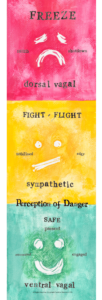
RED — Dorsal Vagal — Freeze or shutdown. The body presents as brain fog, withdrawal, exhaustion despite effort and going through the motions in a way that from the outside often looks like disengagement. Physiologically the body has moved past mobilising and into conserving, which is the nervous system’s last resort response to threat or chronic overload.
YELLOW — Sympathetic Activation — Fight or flight. The body presents as anxious, urgent, irritable, defensive or overworking, with heightened sensitivity to noise, demand and pressure. Physiologically the body is mobilised for threat even when the apparent threat is a deadline or a difficult meeting rather than any actual physical danger.
GREEN — Ventral Vagal — Safe and connected. The body presents as calm, focused and able to think clearly and contribute meaningfully to the work in front of it. This is the state in which performance, creativity, collaboration and wellbeing all become genuinely possible. It is the state every workshop in the suite is designed to widen access to for individuals and teams alike.
Built For Everyone In The Workplace
The workshops are designed to land across everyone in the workplace with three distinct audiences receiving meaningful value from a single session delivered in the same room.
The workforce.
Employees and individual contributors who attend the lunch and learn itself. They walk away with a vocabulary, a framework and the recognition that what they are experiencing has a name and a physiology behind it that is shared by many of their colleagues.
The leaders.
Team leaders, supervisors, line managers, senior leaders and executives in attendance. This is the primary audience because the work is largely about spotting it in real time. They walk away with a way of recognising what is actually happening in their teams and a clear sense of what to do about it in the next one to one.
The people function.
HR, people leaders, owners and founders responsible for the policies and frameworks the organisation operates by. They walk away with a policy framework template that strengthens what they already have and a much clearer view of where their workforce capacity actually sits at any given moment.

Building A Workplace Wellbeing Programme
Most organisations do not deliver one workshop in isolation. The conversations build on each other meaningfully across the year. The language compounds across teams the more often it is encountered. The Traffic Lights of Tolerance™ framework sticks more deeply in workplace conversation the more repeatedly it is heard in different contexts. There are four ways to bring this work into a workplace, each one designed to suit a different organisational moment.
- Workplace Wellbeing Workshop. A single session that works as a focused pilot or for a single topic priority where the business case is already clear and the organisation is ready to move quickly.
- The Workplace Wellbeing Quarter. Three workshops positioned every four to six weeks across a quarter, designed as a focused programme around a particular EDI calendar moment or an engagement survey window.
- The Workplace Wellbeing Half-Year. Five workshops sequenced across the half year as the workplace’s wellbeing rhythm for the next six months.
- The Workplace Wellbeing Year. The full annual programme of all seven workshops delivered as one workshop per month with a break across the year.
Every workshop in every bundle ships as one complete package with the Workshop Deck, the Manager Response Guide and the Implementation and Policy Template included as standard. There are no add-ons to negotiate and no separate purchases to make.
What Changes When The Work Lands
When trauma informed and nervous system led wellbeing workshops sit at the nervous system level rather than at the awareness level alone, the outcomes shift across the organisation in ways that show up in genuinely measurable places. Managers stop seeing behaviour and start seeing the body, which changes what they say in the one to ones that follow and equally what they stop saying. Employees stop masking and self-editing, which is the precise moment at which capacity, creativity and discretionary effort start to become available again to the business. HR teams strengthen what is already in place rather than constantly rewriting policy from scratch. Conversations that have been waiting to happen across the organisation finally have the language and the permission to happen openly.
This is the difference between awareness training and capacity building as organisational disciplines. It is the difference between knowing what burnout looks like in theory and being able to do something practical about it before it costs the business its most experienced and most committed people.
Ready To Bring These Conversations Into Your Workplace?
This is the next generation of workplace wellbeing.
Real conversations and real change for the workplace your people are actually living in every day.

Want to deliver this work in your community as a certified practitioner?
Explore our practitioner pathway and partner network.
Make Contact
Trading Address:
West Tithe
Pury Hill Business Park
Northants, NN12 7LS.